
-20%

Adaptive Hybrid Retrieval with Cross-Encoder Reranking

0 Orders 0 Wish listed

₹4,999.00

Qty
Total price:
  ₹4,999.00

Detail Description

1. Abstract

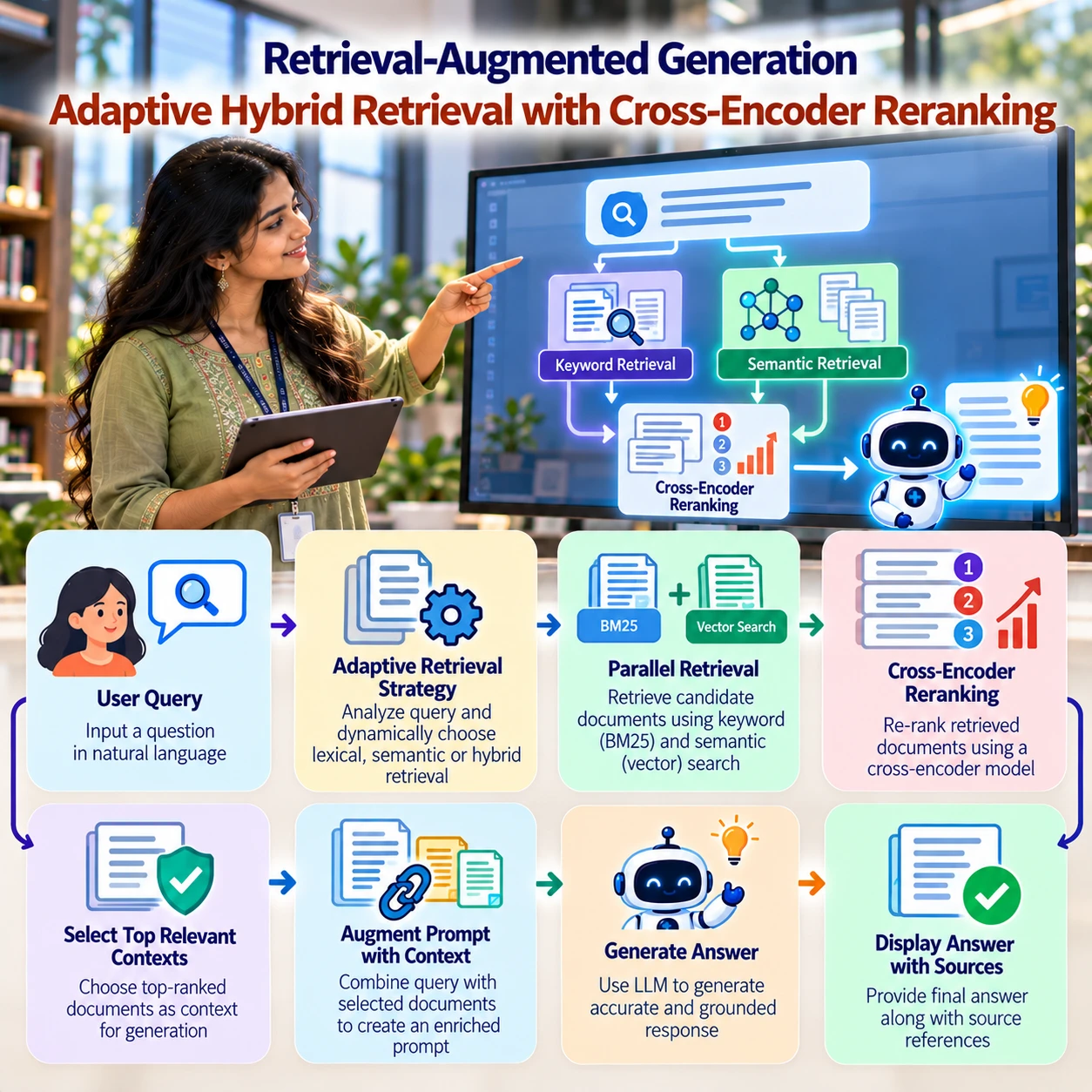
The Adaptive Hybrid Retrieval with Cross-Encoder Reranking system is an AI-powered information retrieval solution designed to improve search accuracy in Retrieval-Augmented Generation (RAG) applications. Traditional retrieval methods often rely on either keyword-based search or semantic vector search, which may fail to retrieve relevant documents when queries contain technical terminology, ambiguous expressions, or context-dependent information. The proposed system combines keyword retrieval, such as BM25, with dense vector similarity search to identify a broader set of relevant documents. An adaptive retrieval mechanism adjusts the contribution of each retrieval method according to query characteristics or retrieval performance. A cross-encoder model then evaluates each query-document pair jointly and reranks the candidate results according to their relevance. The final ranked passages can be supplied to an LLM to generate context-aware answers. This approach aims to improve retrieval precision, relevance, and the quality of downstream RAG responses.

2. Objectives

  1. To develop a hybrid information retrieval system combining keyword and semantic search.
  2. To integrate BM25-based lexical retrieval with dense vector retrieval.
  3. To implement adaptive weighting for different query types.
  4. To use cross-encoder reranking to improve document relevance.
  5. To retrieve contextually relevant passages for RAG applications.
  6. To reduce irrelevant and redundant search results.
  7. To improve the quality of context supplied to LLMs.
  8. To evaluate retrieval performance using standard information retrieval metrics.
  9. To compare hybrid retrieval with keyword-only and vector-only baselines.

3. Existing System

Traditional information retrieval systems commonly use keyword-based search or vector-based semantic search. Keyword retrieval performs well when queries share exact terms with relevant documents but may miss semantically similar content. Vector retrieval captures semantic similarity but can overlook exact technical terms, identifiers, or rare keywords. Some RAG systems use fixed hybrid-search weights and return retrieved passages without a dedicated reranking stage.

Disadvantages

  1. Keyword search may miss conceptually related documents.
  2. Vector search may overlook exact technical terminology.
  3. Fixed retrieval weights may not suit every query.
  4. Initial search rankings may contain irrelevant passages.
  5. Similar documents may receive insufficiently differentiated scores.
  6. Poor retrieval quality can reduce the factual quality of LLM-generated answers.
  7. Retrieving too many passages can increase latency and token usage.

4. Proposed System

The proposed system combines multiple retrieval techniques with an adaptive ranking strategy and a cross-encoder reranking stage. First, a user query is processed by both a lexical retrieval engine and a dense vector search engine. The system combines their candidate results using adaptive score weighting or rank fusion.

The merged candidate set is then passed to a cross-encoder, which evaluates each query-document pair together and assigns a relevance score. The system sorts the candidates according to these scores and selects the most relevant passages for downstream use. In a RAG application, the selected passages are supplied to an LLM with source metadata so that the generated answer can be grounded in retrieved evidence.

Key Features

  1. Hybrid keyword and semantic retrieval.
  2. BM25 lexical search.
  3. Dense vector similarity search.
  4. Adaptive retrieval weighting or rank fusion.
  5. Cross-encoder-based document reranking.
  6. Duplicate-result removal.
  7. Configurable top-k retrieval and reranking.
  8. Context selection for RAG applications.
  9. Source references and document metadata.
  10. Retrieval performance dashboard.
  11. Comparison of retrieval strategies.

5. Implementation Procedure

1. Collect the document corpus: Gather relevant documents, articles, technical manuals, or research papers for the target application.

2. Preprocess the documents: Extract text, clean formatting, preserve metadata, and divide long documents into manageable chunks.

3. Implement keyword retrieval: Use a BM25 engine, such as Elasticsearch, OpenSearch, or the BM25 implementation available through a compatible search library.

4. Implement dense retrieval: Generate document embeddings using a sentence-transformer model and store them in FAISS, ChromaDB, or another vector database.

5. Process user queries: Normalize queries where appropriate and generate query embeddings for semantic search.

6. Retrieve candidate documents: Execute keyword and vector searches independently to obtain candidate passages from both retrieval methods.

7. Implement adaptive fusion: Combine retrieval results using normalized scores, query-dependent weights, or rank-fusion methods such as Reciprocal Rank Fusion (RRF).

8. Integrate a cross-encoder: Use a model such as a compatible Sentence Transformers cross-encoder to score each query-document pair jointly.

9. Rerank the candidates: Sort the candidate passages by cross-encoder relevance scores and select the top-ranked results.

10. Integrate the RAG generator: Supply the selected passages and source metadata to an LLM to generate an answer based on the retrieved evidence.

11. Develop the dashboard: Display search results, relevance scores, source documents, and comparisons between initial and reranked rankings.

12. Evaluate retrieval quality: Measure Recall@K, Precision@K, Mean Reciprocal Rank (MRR), and Normalized Discounted Cumulative Gain (NDCG).

13. Benchmark performance: Compare BM25-only, vector-only, fixed hybrid, adaptive hybrid, and cross-encoder-reranked retrieval configurations.

14. Optimize deployment: Measure latency, candidate-set size, and resource usage to balance retrieval quality against processing cost.

6. Software Requirements

ComponentRequirements
Programming LanguagePython 3.10+ or compatible version
Development EnvironmentVS Code, PyCharm, or Jupyter Notebook
Keyword RetrievalBM25, Elasticsearch, or OpenSearch
Embedding ModelSentence Transformers or compatible embedding API
Vector DatabaseFAISS or ChromaDB
Cross-EncoderSentence Transformers cross-encoder model
RAG FrameworkLangChain or LlamaIndex, optionally
LLMCompatible hosted API or local language model
Data ProcessingPandas and NumPy
Evaluationranx, BEIR utilities, or custom ranking metrics
BackendFlask or FastAPI
FrontendStreamlit or React.js
Operating SystemWindows or Linux

7. Hardware Requirements

ComponentMinimum / Suggested Configuration
ProcessorIntel Core i5 or equivalent
RAM8 GB minimum; 16 GB recommended
Storage10–20 GB free space, depending on corpus size
GPUOptional for small experiments; recommended for larger local models
GPU MemoryDepends on embedding and cross-encoder model size
InternetRequired for hosted LLM or embedding APIs

Note: Cross-encoder reranking adds computation because each candidate query-document pair must be scored. Reranking a smaller candidate set and using batching can help balance latency and accuracy.

8. Advantages of the Project

  1. Improved search relevance: Combines lexical matching with semantic understanding.
  2. Better ranking quality: Uses cross-encoder scoring to refine initial retrieval results.
  3. Adaptive retrieval: Can adjust retrieval behavior according to query characteristics.
  4. Reduced irrelevant context: Helps select more useful passages for LLM generation.
  5. Technical-term support: Combines exact keyword matching with semantic similarity.
  6. Flexible architecture: Supports multiple embedding models and retrieval backends.
  7. Measurable performance: Enables quantitative comparison of retrieval methods.
  8. RAG integration: Supplies higher-ranked passages to downstream language models.
  9. Configurable trade-offs: Allows developers to balance accuracy, latency, and compute cost.
  10. Reusable design: Can support document search, enterprise knowledge bases, and question-answering applications.


No review given yet!

Fast Delivery all across the country
Safe Payment
7 Days Return Policy
100% Authentic Products

You may also like

View all

Quantum Machine Learning-Based Intrusion Detection

₹4,999.00

Digital-Twin-Based Adaptive Intrusion Detection

₹4,999.00

Federated Intrusion Detection for Distributed Networks

₹4,999.00

Cloud Intrusion Detection using Optimized Neural Networks

₹4,999.00

IoT Botnet Attack Detection

₹4,999.00

Adaptive Hybrid Retrieval with Cross-Encoder Reranking
₹4,999.00 ₹0.00
₹4,999.00
4999