
-20%

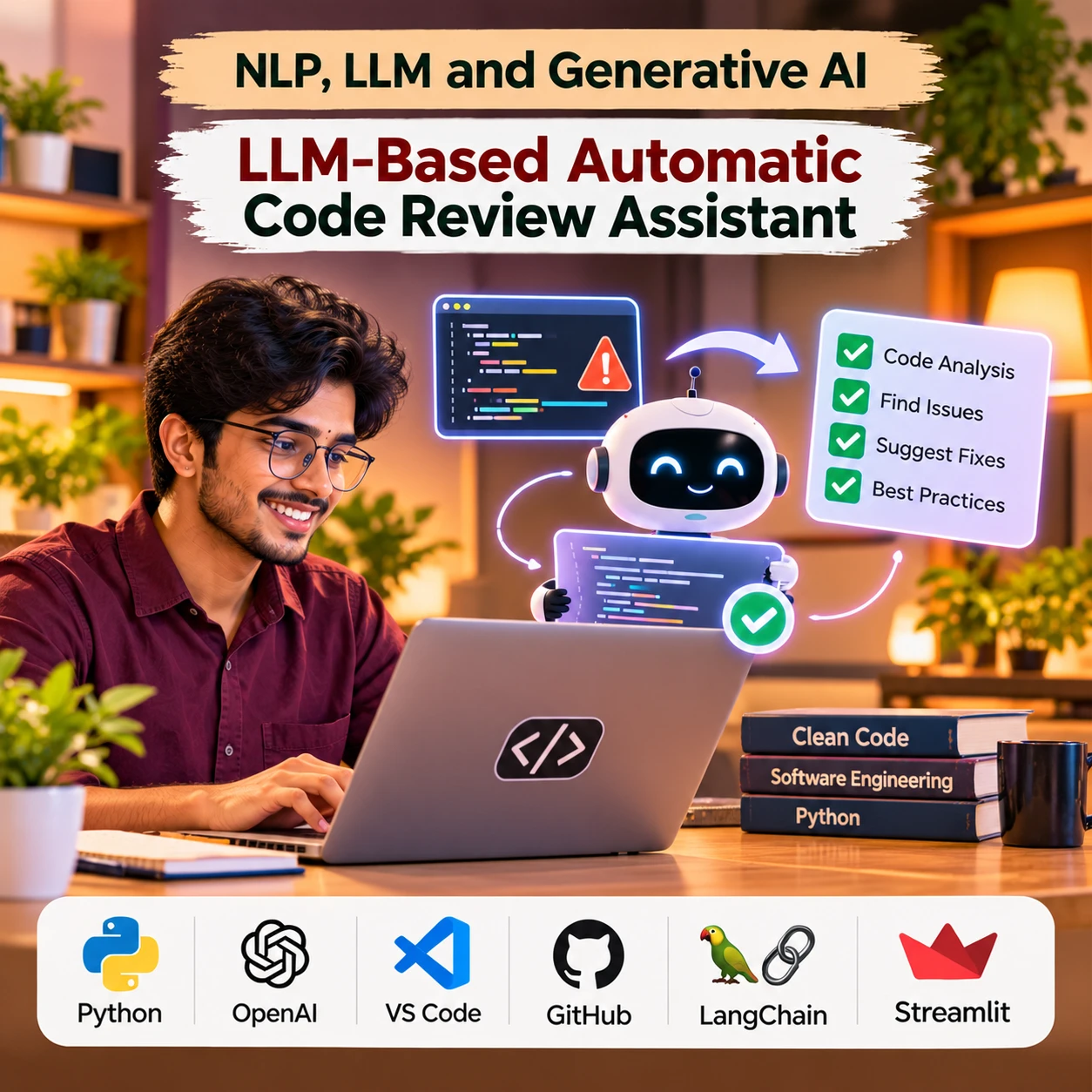
LLM-Based Automatic Code Review Assistant

0 Orders 0 Wish listed

₹4,999.00

Qty
Total price:
  ₹4,999.00

Detail Description

1. Abstract

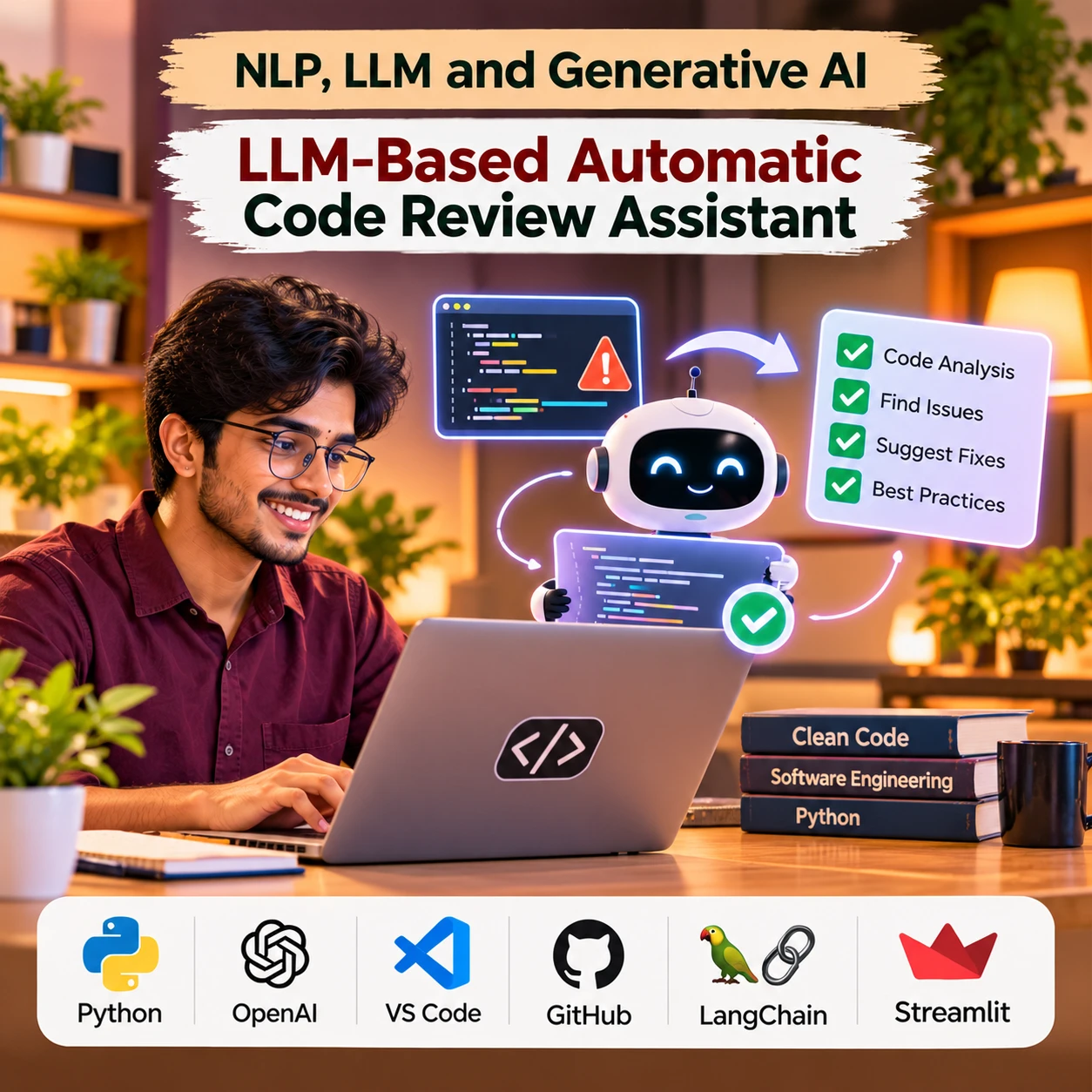
The LLM-Based Automatic Code Review Assistant is an AI-powered software development project designed to analyze source code, identify potential defects, and provide intelligent code improvement suggestions using Large Language Models (LLMs). Traditional code reviews often require significant developer time and depend on manual inspection or predefined static-analysis rules. The proposed system combines LLM-based reasoning with code analysis tools to review submitted code for potential bugs, readability issues, coding-standard violations, security weaknesses, and performance concerns. It generates review comments with explanations and recommended fixes, helping developers understand and improve their code quality. The application can support multiple programming languages and provide an interactive dashboard for uploading code, viewing findings, and comparing original code with suggested improvements. The system assists developers in the review process but requires human verification before suggested changes are accepted.

2. Objectives

  1. To automate preliminary source-code review using Large Language Models.
  2. To identify potential bugs, logical errors, and code-quality issues.
  3. To detect common security vulnerabilities and unsafe coding practices.
  4. To provide understandable explanations for identified issues.
  5. To recommend code corrections and optimization techniques.
  6. To support source-code analysis for multiple programming languages.
  7. To integrate static-analysis tools with LLM-generated insights.
  8. To reduce repetitive manual review effort and improve developer productivity.
  9. To evaluate the accuracy and usefulness of generated review comments.

3. Existing System

Traditional code-review processes primarily rely on manual peer reviews, rule-based linters, and static-analysis tools. Manual reviews can identify complex design and logic problems but require time and experienced reviewers. Linters and static-analysis tools efficiently detect predefined patterns, formatting problems, and some common vulnerabilities, but may not fully understand the intent or business logic of the code.

Disadvantages

  1. Manual code review can be time-consuming.
  2. Review quality may vary depending on developer experience.
  3. Rule-based tools may miss context-dependent logic errors.
  4. Some tool findings may produce false positives.
  5. Developers may need to consult multiple tools for different types of issues.
  6. Traditional tools may provide limited explanations for complex findings.

4. Proposed System

The proposed system uses an LLM to examine source code and generate context-aware review comments. Users submit code through a web interface or upload source files. The application validates the input, optionally runs static-analysis tools, and sends the code and relevant analysis results to an LLM with a structured review prompt.

The model produces findings categorized by severity, issue type, code location, explanation, and recommended correction. Where possible, the system displays corrected code alongside the original snippet. Static-analysis results can be used to corroborate model findings, while duplicate or unsupported comments can be filtered before presenting the final report.

Key Features

  1. Source-code upload and text-editor input.
  2. Multi-language review support, depending on the selected model and analyzers.
  3. Potential bug and logic-error identification.
  4. Code readability and maintainability analysis.
  5. Security and performance review suggestions.
  6. Severity-based issue categorization.
  7. Suggested fixes with explanations.
  8. Static-analysis integration.
  9. Original-versus-improved code comparison.
  10. Downloadable review reports.
  11. Human approval before applying changes.

5. Implementation Procedure

1. Select the technology stack: Choose Python for the backend, an LLM API or locally hosted model, and Streamlit or React for the user interface.

2. Build the input module: Allow users to paste source code or upload supported source files. Validate file extensions and size limits.

3. Preprocess the code: Extract the source text, identify the programming language, and split large files into manageable sections while preserving line numbers and context.

4. Integrate the LLM: Connect to a compatible hosted or local language model capable of code understanding and generation.

5. Design the review prompt: Instruct the model to identify issues, explain their impact, suggest fixes, and return structured results without inventing unsupported findings.

6. Integrate static analysis: Use tools such as Ruff or Pylint for Python, ESLint for JavaScript, and Bandit for selected Python security checks. Tool selection depends on the supported languages.

7. Generate review findings: Combine LLM output and analyzer results into a common format containing the issue category, severity, line number when available, explanation, and suggested correction.

8. Validate the findings: Check output structure, remove duplicate comments, and distinguish confirmed analyzer results from model-generated suggestions that require verification.

9. Develop the dashboard: Display source code, issue summaries, detailed comments, severity indicators, and proposed fixes.

10. Test the application: Evaluate it with code samples containing known bugs, style issues, and security problems. Measure precision, recall where ground truth is available, false-positive rate, and usefulness of suggested fixes.

11. Deploy the system: Package the application for local or cloud use, protect API credentials, and avoid storing sensitive source code unnecessarily.

6. Software Requirements

ComponentRequirements
Programming LanguagePython 3.10+ or a version compatible with the selected libraries
Development EnvironmentVS Code, PyCharm, or Jupyter Notebook
AI ModelCompatible hosted LLM API or local code-capable language model
AI IntegrationProvider SDK or Transformers
Code AnalysisRuff, Pylint, Bandit, ESLint, or equivalent tools
BackendFlask or FastAPI
FrontendStreamlit or React.js
Data ProcessingPython standard libraries, Pandas optionally
Report GenerationJSON, CSV, or PDF libraries as required
Version ControlGit and GitHub
Operating SystemWindows or Linux
InternetRequired for hosted model APIs and online deployment

7. Hardware Requirements

ComponentMinimum / Suggested Configuration
ProcessorIntel Core i5 or equivalent
RAM8 GB minimum; 16 GB recommended
Storage10–20 GB of available space, depending on dependencies and models
GPUOptional when using a hosted LLM API; recommended for local model inference
GPU MemoryDepends on the local model size, quantization, and context length
InternetRequired for hosted LLM APIs and cloud deployment

Note: Hardware requirements increase when a large code model is hosted locally. API-based implementations can run on a standard development computer, subject to the provider's requirements.

8. Advantages of the Project

  1. Faster preliminary reviews: Automates repetitive checks and initial feedback.
  2. Context-aware suggestions: Uses code context to explain potential problems.
  3. Improved readability: Recommends clearer naming, structure, and maintainability improvements.
  4. Security awareness: Highlights potential vulnerabilities for further investigation.
  5. Actionable feedback: Provides explanations and possible corrections alongside findings.
  6. Flexible integration: Can combine LLMs with language-specific static-analysis tools.
  7. Developer learning: Helps junior developers understand coding mistakes and best practices.
  8. Consistent reporting: Presents findings in a structured format.
  9. Extensible architecture: Additional languages, analyzers, and models can be integrated later.


No review given yet!

Fast Delivery all across the country
Safe Payment
7 Days Return Policy
100% Authentic Products

You may also like

View all

LLM Safety, Toxicity and Prompt-Injection Detection

₹4,999.00

Long-Document Information Extraction using LLMs

₹4,999.00

AI Meeting Transcription and Action-Item Generator

₹4,999.00

Explainable Automatic Essay Evaluation

₹4,999.00

LLM-Based Synthetic Dataset Generation

₹4,999.00

LLM-Based Automatic Code Review Assistant
₹4,999.00 ₹0.00
₹4,999.00
4999