-20%

LLM-Based Industrial Maintenance Assistant

0 Orders 0 Wish listed

₹4,999.00

Qty
Total price:
  ₹4,999.00

Detail Description

LLM-Based Industrial Maintenance Assistant

1. Abstract

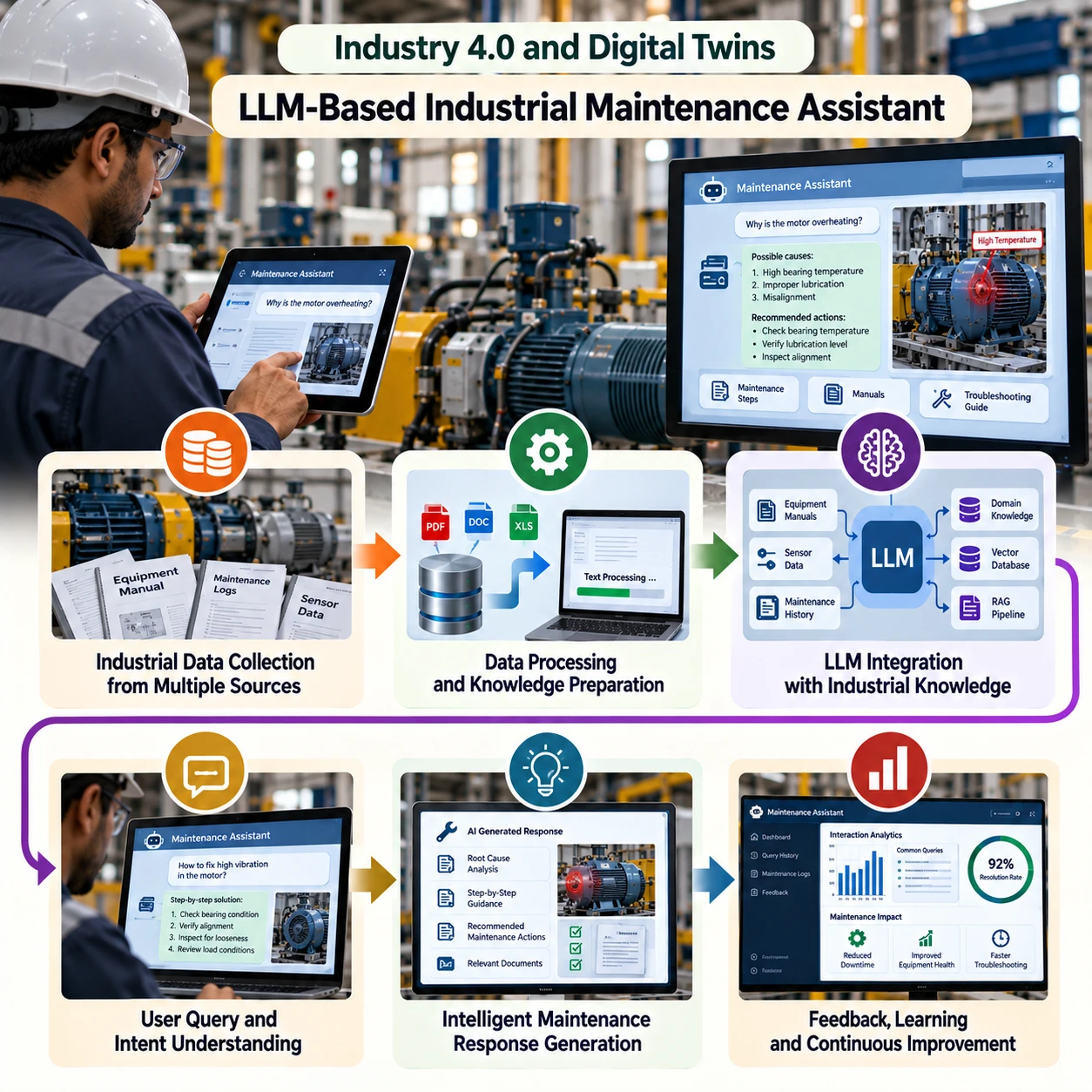
The LLM-Based Industrial Maintenance Assistant is an intelligent application that uses Large Language Models (LLMs) and Natural Language Processing (NLP) to assist technicians and engineers in diagnosing equipment problems and accessing maintenance information. The system allows users to ask questions about machine faults, maintenance procedures, troubleshooting steps, equipment manuals, and safety guidelines using natural language. It can integrate Retrieval-Augmented Generation (RAG) to retrieve relevant information from industrial manuals, technical documents, and maintenance records before generating context-aware responses. The application provides troubleshooting recommendations, maintenance instructions, and equipment-related information through an interactive chatbot interface. By simplifying access to technical knowledge, the proposed system helps reduce troubleshooting time, improve maintenance productivity, and support informed decision-making in industrial environments.

2. Objectives

  1. To develop an AI-powered industrial maintenance assistant using Large Language Models.
  2. To enable users to ask maintenance-related questions using natural language.
  3. To provide troubleshooting guidance for common industrial equipment problems.
  4. To integrate industrial manuals, technical documents, and maintenance records as knowledge sources.
  5. To implement Retrieval-Augmented Generation (RAG) for context-aware responses.
  6. To help technicians identify possible causes of equipment failures.
  7. To provide step-by-step maintenance guidance based on available documentation.
  8. To reduce the time required to search for technical information.
  9. To improve maintenance efficiency and knowledge sharing.
  10. To provide a user-friendly chatbot interface for industrial maintenance support.

3. Existing System

Traditional industrial maintenance support relies on printed manuals, PDF documents, technical support teams, and the experience of maintenance personnel. When a machine develops a fault, technicians often search through documentation or consult experienced engineers to identify the problem and determine the appropriate corrective action.

Although some organizations use digital maintenance management systems, accessing relevant information may still require manual searching. Traditional systems may not support natural-language queries or provide context-aware answers across multiple technical documents.

Disadvantages of the Existing System

  1. Searching technical manuals can be time-consuming.
  2. Troubleshooting often depends on experienced technicians.
  3. Maintenance information may be distributed across multiple documents.
  4. Manual interpretation of technical documentation can delay repairs.
  5. Knowledge sharing between maintenance teams may be limited.
  6. Generic support systems may not provide equipment-specific answers.
  7. Repeated maintenance questions can increase the workload of technical teams.

4. Proposed System

The proposed system uses a Large Language Model combined with a searchable industrial knowledge base to provide intelligent maintenance assistance. Users can enter questions about equipment failures, maintenance procedures, error codes, troubleshooting methods, and technical documentation through a chatbot interface.

The system processes the user's query, retrieves relevant information from uploaded industrial manuals and maintenance documents, and generates a response using an LLM. Retrieval-Augmented Generation helps ground responses in the available documentation and can provide references to the source documents.

The application can also maintain conversation context, organize maintenance questions, and present structured troubleshooting steps. Safety-critical instructions are handled cautiously, with users directed to approved procedures and qualified personnel when necessary.

Key Features

  1. AI-powered industrial maintenance chatbot.
  2. Natural-language question answering.
  3. Retrieval-Augmented Generation (RAG).
  4. Uploading and searching industrial manuals and PDF documents.
  5. Equipment troubleshooting assistance.
  6. Maintenance procedure recommendations based on documentation.
  7. Technical error-code explanations.
  8. Source references for retrieved information.
  9. Conversation history and query management.
  10. User-friendly web interface.
  11. Optional administrator dashboard for managing knowledge documents.

5. Implementation Procedure

Step 1: Requirement Analysis

Identify the target industrial equipment, common maintenance problems, user requirements, and types of technical documents needed for the knowledge base.

Step 2: Data Collection

Collect relevant equipment manuals, maintenance guides, troubleshooting documents, safety instructions, and historical maintenance records. Use authorized documents and remove sensitive information before uploading.

Step 3: Document Processing

Use Python libraries to extract text from PDF and text documents. Clean the extracted content and divide it into smaller, meaningful text segments.

Step 4: Embedding Generation

Convert document segments into numerical vector representations using an embedding model. These embeddings help the system identify documents relevant to a user's question.

Step 5: Vector Database Integration

Store document embeddings and associated metadata in a vector database such as FAISS or ChromaDB. This enables similarity-based retrieval of relevant technical information.

Step 6: LLM Integration

Integrate a suitable Large Language Model through an API or a locally hosted model. Configure it to generate clear, structured maintenance responses grounded in retrieved information.

Step 7: RAG Pipeline Development

Implement the Retrieval-Augmented Generation workflow:

  1. Accept the user's maintenance question.
  2. Convert the question into an embedding.
  3. Retrieve relevant document segments.
  4. Provide the retrieved content to the LLM.
  5. Generate a context-aware answer.
  6. Display the answer with available source references.

Step 8: Chatbot Interface Development

Develop a web interface using Streamlit or Flask. Include a chat window, document upload functionality, source references, and conversation history.

Step 9: Safety and Response Validation

Configure the assistant to distinguish documented procedures from uncertain recommendations. Test it for unsupported claims, incorrect troubleshooting advice, and potentially unsafe instructions. Require qualified personnel to verify safety-critical actions.

Step 10: Testing and Evaluation

Test the application using questions related to equipment faults, maintenance schedules, error codes, and technical procedures. Evaluate retrieval relevance, answer accuracy, source correctness, response time, and user experience.

6. Software Requirements

ComponentRequirements
Programming LanguagePython
Development EnvironmentVisual Studio Code, Jupyter Notebook
LLM FrameworkLangChain or LlamaIndex
Language ModelOpenAI API or a compatible open-source LLM
Embedding ModelSentence Transformers or a compatible embedding API
Vector DatabaseFAISS or ChromaDB
Document ProcessingPyMuPDF, pypdf
Backend FrameworkFlask or FastAPI
Frontend FrameworkStreamlit
Data ProcessingPandas, NumPy
Database (Optional)SQLite or PostgreSQL
Operating SystemWindows or Linux

7. Hardware Requirements

ComponentRequirements
ProcessorIntel Core i3 or higher
RAMMinimum 8 GB recommended
StorageAt least 10 GB of available space
ComputerDesktop or laptop
Internet ConnectionRequired when using cloud-based LLM and embedding APIs
GPUOptional for API-based implementations
Dedicated GPURecommended for running larger local language models
Industrial EquipmentNot required for a documentation-based prototype

Note: A basic prototype can run on a standard laptop using an LLM API and a small collection of industrial manuals. Hardware requirements increase when hosting large language models locally.

8. Advantages of the Project

  1. Faster Troubleshooting: Helps technicians find relevant maintenance information without manually searching lengthy documents.
  2. 24/7 Assistance: Provides access to the chatbot whenever the application and its underlying services are available.
  3. Natural-Language Interaction: Allows users to ask technical questions in simple, conversational language.
  4. Centralized Knowledge: Brings information from multiple maintenance manuals and technical documents into a searchable system.
  5. Context-Aware Responses: Uses retrieved documentation to generate relevant answers.
  6. Improved Productivity: Reduces time spent searching for troubleshooting instructions.
  7. Knowledge Sharing: Helps make documented maintenance knowledge accessible to different team members.
  8. Scalable Knowledge Base: Allows additional equipment manuals and maintenance documents to be incorporated.
  9. Source-Based Answers: Can provide references to supporting documents for verification.
  10. Reduced Support Workload: Helps answer routine maintenance questions and allows engineers to focus on complex problems.
  11. Cost Efficiency: May reduce troubleshooting delays and unnecessary support effort.
  12. Industry 4.0 Compatibility: Supports digital knowledge management and intelligent industrial maintenance workflows.


No review given yet!

Fast Delivery all across the country
Safe Payment
7 Days Return Policy
100% Authentic Products

You may also like

View all

Reinforcement Learning-Based Robotic Process Control

₹4,999.00

Energy Optimization for Smart Manufacturing

₹4,999.00

OPC UA Information Modelling using LLM Agents

₹4,999.00

Multi-Agent Production Scheduling System

₹4,999.00

Digital Twin-Based Manufacturing Anomaly Detection

₹4,999.00

LLM-Based Industrial Maintenance Assistant
₹4,999.00 ₹0.00
₹4,999.00
4999