
-20%

OPC UA Information Modelling using LLM Agents

0 Orders 0 Wish listed

₹4,999.00

Qty
Total price:
  ₹4,999.00

Detail Description

OPC UA Information Modelling Using LLM Agents

1. Abstract

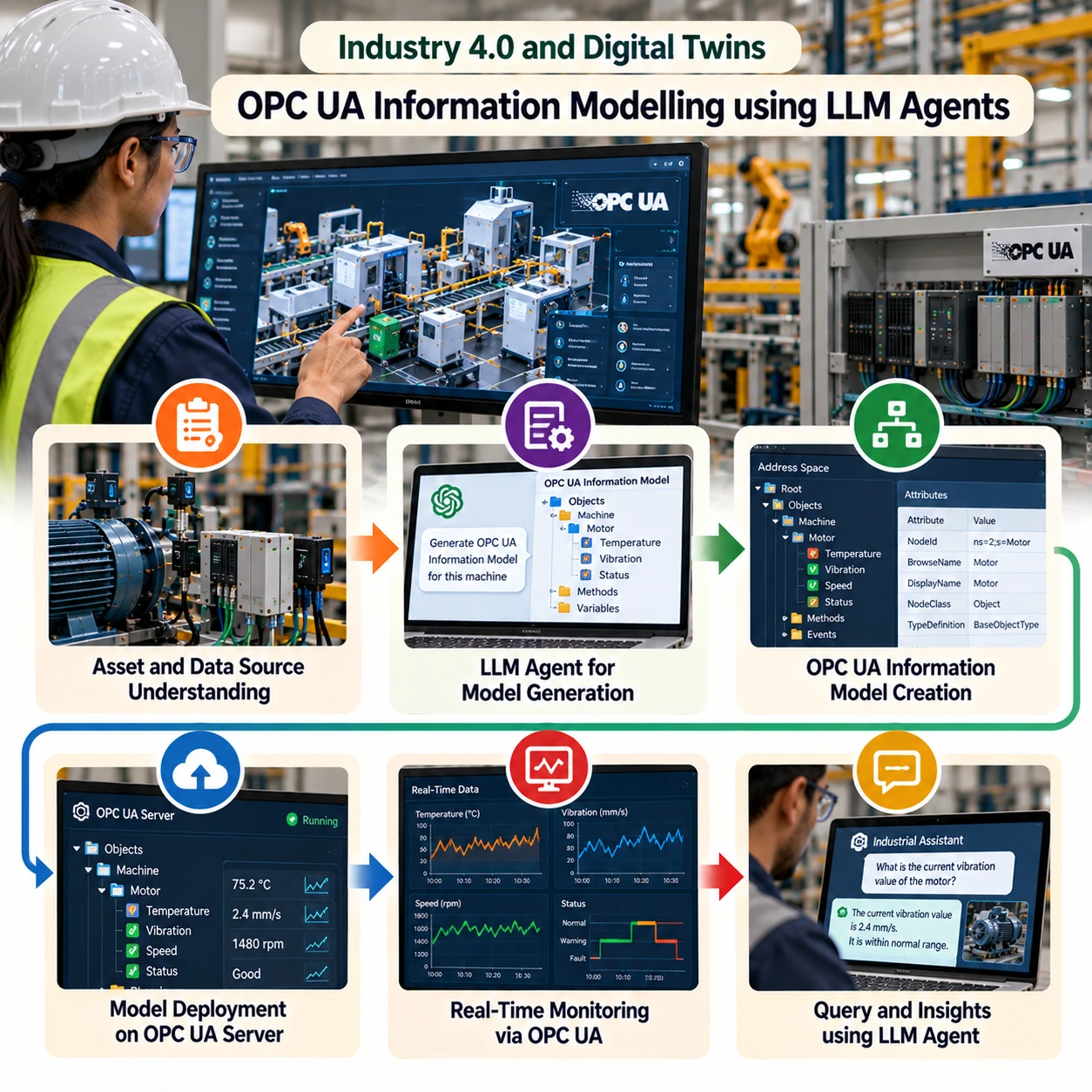
OPC UA Information Modelling Using LLM Agents is an intelligent industrial automation system that combines Open Platform Communications Unified Architecture (OPC UA) with Large Language Models (LLMs) to simplify the creation and management of industrial information models. OPC UA provides a standardized framework for representing industrial devices, processes, variables, and relationships. The proposed system uses LLM-powered agents to interpret natural-language descriptions of industrial equipment and convert them into structured OPC UA information models. The agents assist in identifying relevant variables, defining object types, establishing relationships, and generating model configurations. The system can validate generated models against predefined rules and present the results through an interactive interface. This approach aims to reduce manual modelling effort, improve consistency, and simplify industrial system integration. It supports smart manufacturing, industrial interoperability, and Industry 4.0 applications.

2. Objectives

  1. To develop an intelligent system for creating OPC UA information models using LLM agents.
  2. To interpret natural-language descriptions of industrial equipment and processes.
  3. To automate the generation of OPC UA objects, variables, properties, and relationships.
  4. To reduce the manual effort required for industrial information modelling.
  5. To use multiple LLM agents for model generation, validation, and refinement.
  6. To improve consistency and standardization in industrial information models.
  7. To validate generated models against OPC UA modelling rules and predefined requirements.
  8. To simplify the representation of industrial devices and manufacturing processes.
  9. To support interoperability between industrial automation systems.
  10. To improve the efficiency of Industry 4.0 digitalization initiatives.

3. Existing System

Traditional OPC UA information modelling requires engineers to manually define objects, variables, data types, references, and relationships using specialized modelling tools. Engineers must understand the equipment's technical specifications and the OPC UA information modelling framework to create appropriate models.

Although existing tools support structured model creation and validation, translating unstructured equipment documentation into complete information models can require considerable manual effort.

Disadvantages of the Existing System

  1. Manual modelling requires specialized technical knowledge.
  2. Creating complex information models can be time-consuming.
  3. Translating equipment documentation into structured models requires additional effort.
  4. Inconsistent naming conventions may affect model quality.
  5. Model updates can become difficult when equipment specifications change.
  6. Repeated modelling tasks increase engineering workload.
  7. Integration between different industrial systems may require additional configuration.

4. Proposed System

The proposed system integrates OPC UA information modelling with LLM-powered agents to automate the creation, validation, and refinement of industrial information models.

Users provide equipment descriptions, technical specifications, or industrial process requirements in natural language. An LLM agent analyzes the input and identifies relevant objects, variables, properties, data types, and relationships. A model-generation agent converts these details into a structured OPC UA model representation.

A validation agent checks the generated model against OPC UA modelling rules and project-specific constraints. If errors or inconsistencies are detected, the system can request corrections and regenerate the model. The resulting information model can be reviewed through a web interface and exported in a suitable format for further use with compatible OPC UA tools.

Key Features

  1. Natural-language-based information modelling.
  2. LLM-powered industrial modelling agents.
  3. Automated OPC UA object and variable generation.
  4. Definition of data types, properties, and relationships.
  5. Model validation and error detection.
  6. Automated model refinement.
  7. Equipment documentation analysis.
  8. Structured model export.
  9. Interactive model visualization.
  10. Support for industrial interoperability and Industry 4.0.

5. Implementation Procedure

Step 1: Requirement Analysis

Identify the industrial equipment to be modelled and determine the required OPC UA objects, variables, properties, relationships, and data types.

Step 2: Input Data Collection

Collect equipment specifications, technical documentation, sensor descriptions, and process requirements. These documents will provide the information needed to construct the industrial model.

Step 3: Natural Language Processing

Use an LLM to interpret equipment descriptions and extract important information, including component names, operating parameters, data types, and relationships.

Step 4: Multi-Agent Architecture Design

Develop specialized agents with clearly defined responsibilities:

  1. Requirement Analysis Agent: Extracts modelling requirements from user descriptions.
  2. Model Generation Agent: Creates the proposed OPC UA information model.
  3. Validation Agent: Checks the model for structural inconsistencies and rule violations.
  4. Refinement Agent: Corrects identified issues and improves the generated model.

Step 5: OPC UA Model Generation

Represent the extracted information using appropriate OPC UA concepts, including objects, variables, object types, variable types, properties, and references.

Use a structured representation such as JSON as an intermediate format before generating an OPC UA-compatible model.

Step 6: Model Validation

Validate the generated model against applicable OPC UA specifications and modelling constraints. Check data types, required attributes, references, naming conventions, and structural relationships.

Step 7: Agent-Based Refinement

Provide validation results to the refinement agent. Allow it to propose corrections and regenerate the model for another validation cycle.

Step 8: OPC UA Integration

Use a compatible OPC UA library or modelling tool to create, import, or inspect the generated model. A Python implementation can use the asyncua library for OPC UA client and server functionality where appropriate.

Step 9: Dashboard Development

Build an interface using Streamlit or Flask that allows users to enter equipment descriptions, generate models, inspect model structures, and review validation results.

Step 10: Testing and Evaluation

Test the application using different equipment descriptions and modelling scenarios. Evaluate model correctness, validation success, generation time, and the amount of manual correction required.

Note: LLM-generated models should be validated before industrial deployment. A prototype can generate and validate model definitions without connecting to physical industrial equipment.

6. Software Requirements

ComponentRequirements
Programming LanguagePython
Development EnvironmentVisual Studio Code or PyCharm
Large Language ModelOpenAI API or a compatible LLM
Agent OrchestrationLangGraph or LangChain
OPC UA Libraryasyncua
Data ProcessingPandas, NumPy
Structured Data FormatJSON, XML
Model ValidationOPC UA-compatible validation tools
Frontend FrameworkStreamlit or Flask
Database (Optional)SQLite or PostgreSQL
Operating SystemWindows or Linux

7. Hardware Requirements

ComponentRequirements
ProcessorIntel Core i3 or higher
RAMMinimum 8 GB recommended
StorageAt least 10 GB of available space
ComputerDesktop or laptop
Internet ConnectionRequired for cloud-based LLM APIs
GPUOptional for cloud-based LLM implementations
Industrial Controller (Optional)Compatible PLC or industrial controller
OPC UA Server (Optional)Compatible software or industrial OPC UA server
Network Interface (Optional)Ethernet or another compatible industrial network connection

Note: A software prototype can run on a standard laptop using sample equipment descriptions and a cloud-based LLM. Physical industrial equipment is not required unless real-world integration is part of the project.

8. Advantages of the Project

  1. Reduced Modelling Effort: Automates parts of the OPC UA information modelling process.
  2. Natural-Language Interaction: Allows engineers to describe equipment requirements using ordinary language.
  3. Faster Model Development: Generates initial model structures from equipment documentation.
  4. Improved Consistency: Applies predefined modelling conventions and validation rules.
  5. Automated Validation: Helps identify structural errors and inconsistencies.
  6. Simplified Model Maintenance: Supports updates when equipment descriptions or requirements change.
  7. Multi-Agent Collaboration: Separates requirement analysis, model generation, validation, and refinement tasks.
  8. Improved Interoperability: Supports standardized representation of industrial information through OPC UA.
  9. Reduced Repetitive Work: Helps engineers focus on complex modelling and verification tasks.
  10. Industry 4.0 Compatibility: Supports intelligent industrial digitalization and automation initiatives.


No review given yet!

Fast Delivery all across the country
Safe Payment
7 Days Return Policy
100% Authentic Products

You may also like

View all

Reinforcement Learning-Based Robotic Process Control

₹4,999.00

Energy Optimization for Smart Manufacturing

₹4,999.00

Multi-Agent Production Scheduling System

₹4,999.00

Digital Twin-Based Manufacturing Anomaly Detection

₹4,999.00

LLM-Based Industrial Maintenance Assistant

₹4,999.00

OPC UA Information Modelling using LLM Agents
₹4,999.00 ₹0.00
₹4,999.00
4999