
-20%

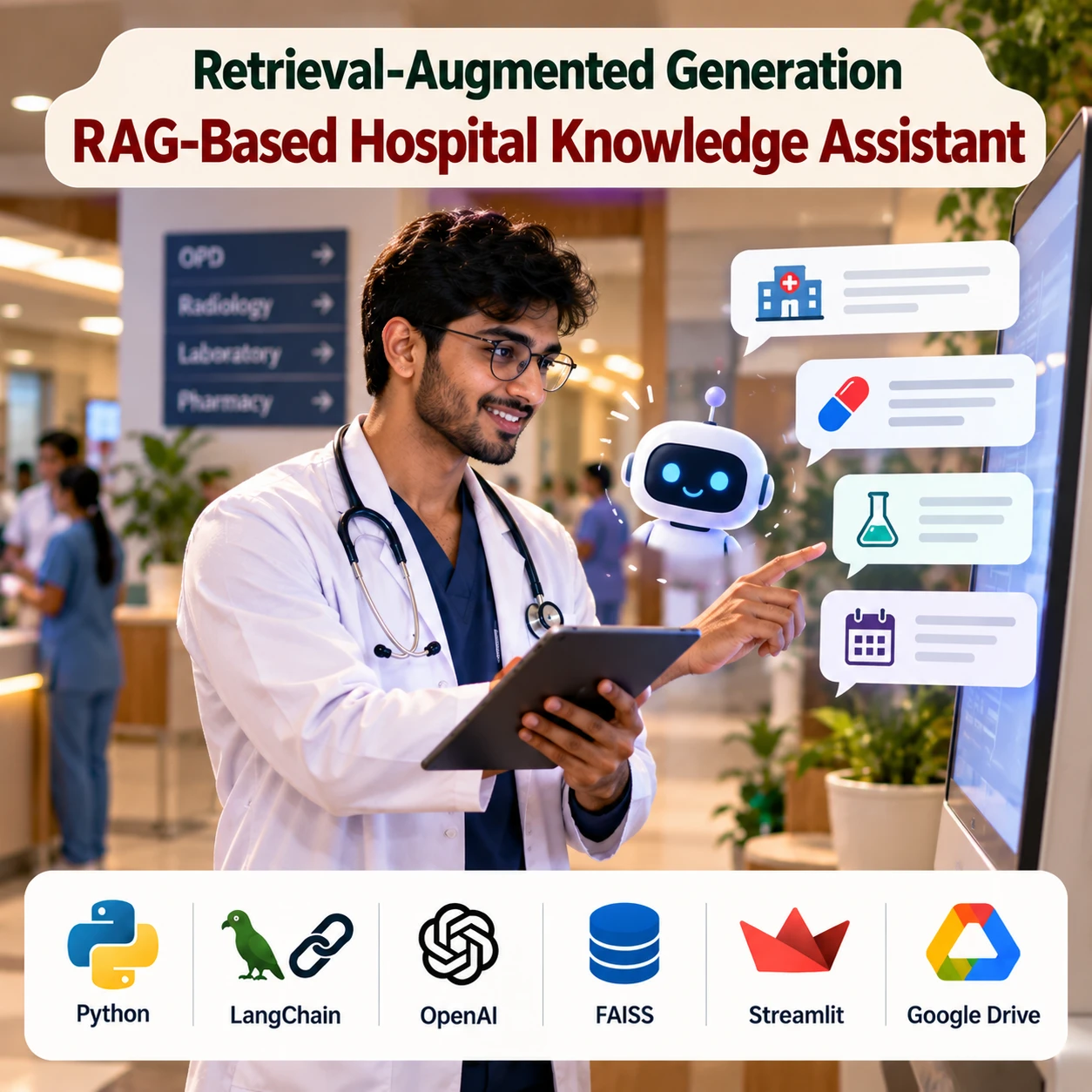
RAG-Based Hospital Knowledge Assistant

0 Orders 0 Wish listed

₹4,999.00

Qty
Total price:
  ₹4,999.00

Detail Description

1. Abstract

The RAG-Based Hospital Knowledge Assistant is an AI-powered application designed to provide reliable, context-aware answers to hospital-related queries using Retrieval-Augmented Generation (RAG) and Large Language Models (LLMs). The system retrieves relevant information from hospital-approved documents, including department details, doctor schedules, visiting hours, admission procedures, medical service information, and frequently asked questions. The retrieved content is supplied to an LLM to generate responses grounded in the available knowledge base. Users can interact with the assistant through a conversational interface to obtain relevant hospital information quickly. The system also provides source references to help users verify responses against the original documents. By combining semantic search with generative AI, the application aims to improve access to hospital information and reduce repetitive inquiries to administrative staff. It is designed for informational support and does not replace professional medical diagnosis or emergency services.

2. Objectives

  1. To develop an AI-powered hospital information assistant using RAG.
  2. To answer hospital-related queries using approved knowledge sources.
  3. To retrieve relevant information from hospital documents.
  4. To generate context-aware responses using an LLM.
  5. To provide source references for generated answers.
  6. To support conversational follow-up questions.
  7. To simplify access to hospital services and administrative information.
  8. To reduce repetitive inquiries handled by hospital reception staff.
  9. To identify questions that cannot be answered from available documents.
  10. To evaluate retrieval accuracy, response relevance, and factual consistency.

3. Existing System

Traditional hospital information systems rely on reception staff, static websites, FAQ pages, and rule-based chatbots to answer patient and visitor questions. Users may need to search multiple pages or contact hospital staff to find information about departments, visiting hours, appointments, and admission procedures. Basic chatbots generally depend on predefined questions and answers, which limits their ability to handle differently worded queries or follow-up questions.

Disadvantages

  1. Manual inquiries can increase the workload of hospital staff.
  2. Static FAQs may be difficult to search.
  3. Rule-based chatbots have limited conversational flexibility.
  4. Information may be scattered across multiple documents.
  5. Generic LLMs may generate unsupported hospital information.
  6. Existing systems may provide limited source references.
  7. Information must be updated when hospital policies or schedules change.

4. Proposed System

The proposed system uses a Retrieval-Augmented Generation pipeline to answer questions using a curated collection of hospital documents. The documents are processed, divided into smaller chunks, converted into vector embeddings, and stored in a vector database. When a user submits a query, the retrieval module searches for relevant passages and provides them to the LLM as context.

The LLM generates an answer based on the retrieved information, while the application displays source references where available. If relevant information cannot be found, the assistant can explain that the information is unavailable and direct the user to the appropriate hospital department. An administrator can update the knowledge base when hospital information changes.

Key Features

  1. Conversational hospital information assistant.
  2. Retrieval from hospital-approved documents.
  3. Semantic search using vector embeddings.
  4. RAG-based answer generation.
  5. Source citations and document references.
  6. Hospital department and service information.
  7. Doctor schedules and visiting-hour information, when provided in the knowledge base.
  8. Admission, registration, and appointment guidance.
  9. Follow-up questions with conversation context.
  10. Admin dashboard for document management.
  11. Fallback responses for unsupported queries.
  12. Optional multilingual question answering.

5. Implementation Procedure

1. Collect hospital documents: Gather approved information about departments, services, visiting hours, appointment procedures, admission policies, and frequently asked questions.

2. Develop the user interface: Create a chat interface for patients, visitors, and administrative users.

3. Extract document text: Use PyMuPDF or pdfplumber for PDFs and python-docx for Word files. Apply OCR when scanned documents must be processed.

4. Preprocess the documents: Clean extracted text, preserve headings, and remove irrelevant formatting.

5. Split documents into chunks: Divide the content into manageable sections while preserving context and source metadata.

6. Generate embeddings: Use a suitable embedding model to convert document chunks into vector representations.

7. Store the knowledge base: Save the embeddings and associated document metadata in a vector database such as FAISS or ChromaDB.

8. Implement retrieval: Convert user questions into embeddings and retrieve the most relevant document chunks using similarity search.

9. Integrate the LLM: Supply the retrieved passages and the user's question to a compatible LLM with instructions to answer only when sufficient evidence is available.

10. Generate grounded answers: Produce concise responses with supporting source references and a fallback when relevant information is unavailable.

11. Build the admin dashboard: Allow authorized administrators to upload, update, and remove documents from the knowledge base.

12. Evaluate the system: Test retrieval relevance, answer correctness, citation accuracy, response time, and performance on questions absent from the knowledge base.

13. Deploy securely: Protect administrative access, manage API credentials, and avoid uploading confidential patient records unless appropriate authorization and safeguards are in place.

6. Software Requirements

ComponentRequirements
Programming LanguagePython 3.10+ or compatible version
Development EnvironmentVS Code, PyCharm, or Jupyter Notebook
AI ModelCompatible hosted LLM API or local language model
RAG FrameworkLangChain or LlamaIndex
Embedding ModelSentence Transformers or a compatible embedding API
Vector DatabaseFAISS or ChromaDB
PDF ProcessingPyMuPDF or pdfplumber
Word Processingpython-docx
BackendFlask or FastAPI
FrontendStreamlit or React.js
Data ProcessingPandas and NumPy
Optional DatabaseSQLite or PostgreSQL
Operating SystemWindows or Linux
InternetRequired for hosted model APIs

7. Hardware Requirements

ComponentMinimum / Suggested Configuration
ProcessorIntel Core i5 or equivalent
RAM8 GB minimum; 16 GB recommended
Storage10–20 GB free space, depending on documents and models
GPUOptional for hosted LLM APIs; recommended for local models
GPU MemoryDepends on the selected model
InternetRequired for cloud-based AI services

Note: A RAG application using hosted LLM and embedding services can run on a standard development computer. Local model deployment may require additional memory and GPU resources.

8. Advantages of the Project

  1. Easy information access: Helps users find hospital information through natural-language questions.
  2. Grounded responses: Uses retrieved hospital documents to inform generated answers.
  3. Source verification: Provides references to relevant source passages.
  4. Reduced staff workload: Automates responses to common administrative questions.
  5. Conversational interaction: Supports follow-up questions.
  6. Centralized knowledge: Organizes information from multiple hospital documents.
  7. Updatable information: Allows administrators to refresh the knowledge base.
  8. Improved accessibility: Can be extended to support multiple languages.
  9. Reduced unsupported answers: Can use retrieval checks and fallback responses when evidence is insufficient.
  10. Scalable design: Supports additional departments and document collections.


No review given yet!

Fast Delivery all across the country
Safe Payment
7 Days Return Policy
100% Authentic Products

You may also like

View all

Quantum Machine Learning-Based Intrusion Detection

₹4,999.00

Digital-Twin-Based Adaptive Intrusion Detection

₹4,999.00

Federated Intrusion Detection for Distributed Networks

₹4,999.00

Cloud Intrusion Detection using Optimized Neural Networks

₹4,999.00

IoT Botnet Attack Detection

₹4,999.00

RAG-Based Hospital Knowledge Assistant
₹4,999.00 ₹0.00
₹4,999.00
4999